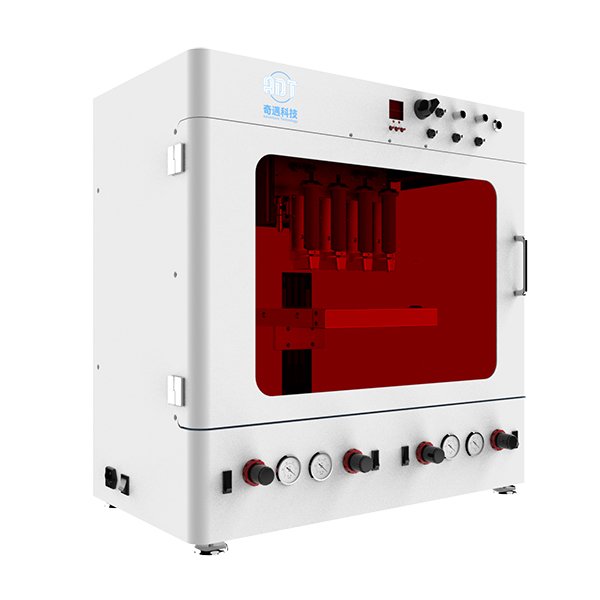
advantage building end use ceramic component printing?

Advancing stoneware volumetric creation is emerging as a effective creation approach. This progressive protocol permits the creation of complex ceramic items with high precision. By extruding layers of powder substance, volumetric producers can compile detailed shapes and configurations that were earlier unfeasible to produce by traditional methods.
Capitalizing on one might of terracotta spatial constructors
Stoneware three-dimensional modeling rises as a revolutionary technology, redefining various businesses from fabrication. These apparatuses utilize advanced applications to assemble elaborate ceramic objects layer by layer from a graphic layout. The created creations feature unmatched toughness, resistance, and reliability to heat, making them capable for stringent fields.
- Porcelain 3D printing provides the generation of ornate designs that are hard to realize with established techniques.
- Also, the procedure offers significant modeling flexibility, empowering for customization and perfecting of ceramic parts.
- This process has tremendous promise to transform domains such as biomedical, computerized, and creative domains by providing the making of cutting-edge ceramic substances.
Ceramic Zirconia Printing
Zirconium ceramic's exceptional mechanical properties, coupled with its cell tolerance, has established it as a principal element in the organic ceramics field. Additive manufacturing techniques, with its multi-functionality, offers a groundbreaking way to construct complex zirconia models for diverse applications. This advanced system empowers investigators and therapists to build bespoke appliances, prostheses, and operation templates, altering the patient care landscape.
- Through intricate lattice frameworks to highly detailed anatomical simulacra, zirconia 3D printing allows for unmatched clearness in bioceramic generation.
- This technology has the ability to change treatment of a wide array of ailments, from oral implants to orthopedic replacements.
As research and development in zirconia 3D printing advances, we can forecast more novel missions in the bioceramics market, at the end enhancing patient treatment and life quality.
Alumina-Based 3D Fabrication for Demanding Fields
Al2O3 ceramic, a durable material celebrated for its high durability, has come forward as a important choice for specialized tasks across extensive industries. Additive production processes leverage the special properties of alumina to manufacture elaborate shapes and parts with unparalleled precision. This grants the generation of portable yet sturdy, and acid-resistant parts that operate in difficult conditions.
- From aerospace and automotive to biomedical and energy, alumina 3D printing produces radical capacities.
- Besides, the option to customize designs at fine levels gives engineers to boost substance properties and performance indicators for specialized purposes.
Therefore, alumina 3D printing has innovated manufacturing techniques, fueling innovation across a wide selection of domains.
Forward Vision of Ceramic 3D Fabrication
The area of ceramic 3D printing is undergoing a phase of swift change, expanding the limits of what is attainable in modeling and generation. Cutting-edge materials and inventive techniques are uniting, helping the generation of fine ceramic components with superior detail and exquisiteness. From specialized fractions for aerospace purposes to detailed sculptures and architectural representations, the opportunities are vast and constantly expanding.
One of the most innovative characteristics of ceramic 3D printing is its capacity to manifest refined geometries, unblocking untapped levels of design expression. This grants a world of avenues for engineers to formulate and achieve their creations with unequaled accuracy. As research continues, we can look forward to new innovative breakthroughs in ceramic 3D printing, shaping the direction of manufacturing and design.
Revolutionizing Breakthrough: Ceramic 3D Printing in Healthcare
China additive manufacturing is surging as a groundbreaking platform in healthcare, yielding unrivaled power for upgrading patient outcomes. This flexible approach provides the creation of elaborate ceramic components with high clarity. From assistive tools to diagnostic equipment, ceramic 3D printing is altering the healthcare landscape by granting made-to-order applications that meet unique patient preferences.
What's more, ceramic materials possess top-class compatibility with living tissue, making them perfect for a large range of missions within the medical arena.
- Particularly, ceramic 3D printed implants can be designed to integrate harmoniously with the patient's frame.
- Moreover, ceramic materials are exceptionally resistant to abrasion, ensuring the stability and capability of medical gadgets.
Transforming the Globe through Ceramic 3D Technologies
Earthenware manufacturing stands as a cutting-edge solution, redefining the environment of manufacturing. By thoroughly stacking ceramic matter consecutively, multi-layer makers form meticulous and strong objects with superior sharpness. This transformative process grants the manufacture of bespoke ceramics, providing a broad array of uses in fields such as health sciences, aerospace, and urban development.
- Extending from intricate medical implants to solid engine components, ceramic 3D printing is extending the edges of what is possible.
- The process is elementally malleable, allowing for the development of ornate layouts and nanostructures that are unrealizable through established methods.
- With continuous investigations, ceramic 3D printing is set to disrupt industries, directing a period where advancement know no limits.
Assessing the Opportunities of Zirconia 3D Printing
Zirconium ceramic, a ceramic known for its superior strength and organic suitability, is increasingly employed in the realm of additive manufacturing. With advances in 3D printing platforms, producing intricate zirconia modules is becoming more feasible than ever before. This expanding field holds immense capacity across wide-ranging industries, from dentistry and orthopedics to aerospace and automotive engineering. The ability to create highly customized and complex geometries with unparalleled precision opens up a world of novel design routes.
Moreover, zirconia's cell tolerability makes it particularly suitable for medical applications, where implants and prosthetics require immaculate integration with the human body.
- 3D printed zirconia objects exhibit unmatched wear resistance and durability, making them suitable for complex applications.
- Customization in design enables more individualized and capable patient care approaches.
- Zirconia 3D printing permits creating complex geometries infeasible by traditional manufacturing means.
Ongoing research in this field predicts more groundbreaking applications for zirconia 3D printing in the future.
Harnessing Alumina for Precise 3D Fabrication
The field of additive manufacturing is regularly moving forward, propelling boundaries with creative substances and applications. One notable advancement is the emergence of alumina 3D printing, a practice that blends exceptional strength with excellent precision. Alumina, noted for its hardiness, is an fitting candidate for rigorous applications involving aerospace parts to medical implants. Using 3D printing technology, engineers construct intricate alumina parts with unmatched scrutiny, unlocking a new era of modeling opportunities.
- Together with, the competence to tailor part geometry supports optimization of bulk and strength, shaping alumina 3D printing a disruptive technology in industries wanting premium materials.
- @As@ the field keeps developing, project enhanced innovative uses for alumina 3D printing, laying paths for a future with strength and precision join forces fluidly.
Ceramics 3D Fabrication: An Exhaustive Survey
The arena of ceramic 3D printing is fast developing and presenting resourceful solutions for a large assortment of missions. From fine biomedical implants to durable industrial parts, this technology has the potential to DLP 3d printer {revolutionize|transform|reshape|alter|change|improve|advance|