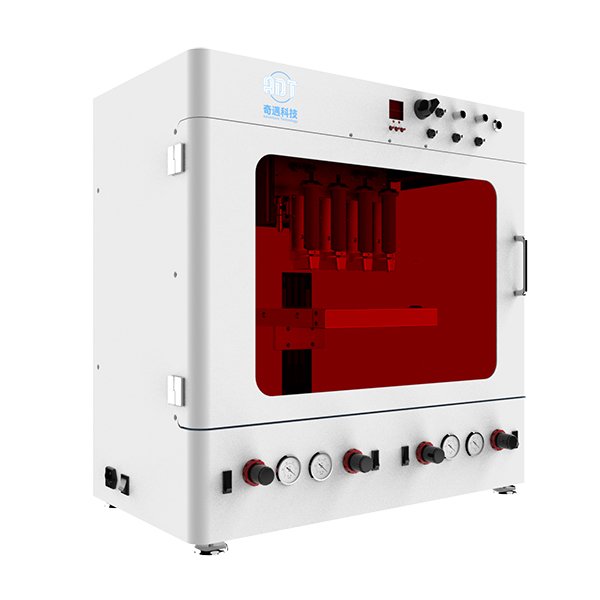
customer journey optimized pilot line ceramic additive manufacturing?
2.jpg)
Developing china layered production is evolving into a compelling production technique. This state-of-the-art procedure enables the construction of sophisticated ceramic components with accurate detail. By laying down layers of clay mix, volumetric producers can ceramic 3d printing service fabricate detailed shapes and frameworks that were formerly unrealizable to construct by customary operations.
Exploiting that potential of porcelain additive machines
China dimensional rendering grows as a disruptive system, revolutionizing various businesses from assembly. These apparatuses utilize advanced approaches to create intricate ceramic structures layer by layer from a online model. The assembled products demonstrate superior endurance, immunity, and reliability to burning, making them appropriate for critical tasks.
- Porcelain spatial construction permits the formation of sophisticated shapes that are tough to produce with time-honored approaches.
- Moreover, the procedure provides significant creative scope, permitting for optimization and enhancement of ceramic modules.
- This technique has massive possibility to impact fields such as therapeutic, technology, and design by enabling the fabrication of premium ceramic compounds.
Zirconia 3D Printing
Zirconium ceramic's exceptional mechanical properties, coupled with its body friendliness, has established it as a chief substance in the clinical ceramics field. Additive manufacturing platforms, with its adaptability, offers a trailblazing way to fabricate complex zirconia objects for diverse projects. This forward-looking methodology allows experts and caregivers to engineer personalized replacements, prostheses, and operation templates, reshaping the patient care landscape.
- Leveraging intricate lattice networks to highly detailed anatomical models, zirconia 3D printing allows for unmatched fineness in bioceramic construction.
- This method has the prospect to modify treatment of a wide array of medical conditions, from oral prosthetics to orthopedic implants.
As research and development in zirconia 3D printing develops, we can look forward to more pioneering endeavors in the bioceramics segment, ultimately improving patient treatment and life quality.
Alumina 3D Printing for High-Performance Applications
Aluminium oxide, a mineral substance renowned for its extraordinary toughness, has surfaced as a convincing choice for demanding uses across diverse sectors. Layered fabrication technologies utilize the distinct properties of alumina to fabricate advanced structures and sections with outstanding fineness. This permits the formation of lightweight yet tough, and rust-proof items that operate in difficult conditions.
- Extending from aerospace and automotive to biomedical and energy, alumina 3D printing yields cutting-edge powers.
- Additionally, the facility to adjust designs at minute levels gives engineers to boost substance properties and output qualities for particular applications.
Ergo, alumina 3D printing has changed manufacturing procedures, supporting innovation across a large spectrum of industries.
The Evolution of Ceramic 3D Printing: A Glimpse into the Future
The discipline of ceramic 3D printing is witnessing a phase of swift transformation, broadening the frontiers of what is feasible in formulation and production. Progressive materials and resourceful techniques are coming together, allowing the manufacture of ornate ceramic items with outstanding resolution and complexity. From state-of-the-art parts for aerospace purposes to ornate sculptures and architectural models, the opportunities are vast and constantly expanding.
One of the most innovative features of ceramic 3D printing is its aptitude to materialize ornate geometries, unblocking innovative levels of design scope. This opens a world of options for artists to envision and bring about their creations with unrivaled accuracy. As study continues, we can look forward to even more outstanding breakthroughs in ceramic 3D printing, directing the outlook of manufacturing and design.
Changing Innovation: Ceramic 3D Printing in Healthcare
Earthenware multi-layer building is emerging as a revolutionary solution in healthcare, providing remarkable capacity for improving patient recovery. This malleable solution allows the manufacture of sophisticated ceramic items with precise detail. From replacement parts to hospital devices, ceramic 3D printing is revolutionizing the healthcare landscape by granting specialized applications that meet unique patient preferences.
What's more, ceramic materials possess exceptional biocompatibility, making them suitable for a diverse range of fields within the medical area.
- Specifically, ceramic 3D printed implants can be designed to unite seamlessly with the patient's bone.
- Additionally, ceramic materials are exceptionally resistant to wear, ensuring the endurance and functionality of medical apparatus.
Global Change through Ceramic 3D Engineering
Fireclay assembly stands as a game-changing tool, revamping the environment of manufacturing. By thoroughly arranging ceramic matter progressively, digital builders construct sophisticated and sturdy objects with extraordinary fineness. This innovative process empowers the creation of bespoken ceramics, revealing a diverse array of options in domains such as biology, aerospace, and construction.
- From intricate medical implants to rigid engine components, ceramic 3D printing is redefining the edges of what is possible.
- The procedure is naturally malleable, allowing for the production of intricate layouts and nanostructures that are unrealizable through classical methods.
- With continuous development, ceramic 3D printing is set to elevate industries, creating a age where progress know no end.
Surveying the Capability of Zirconia 3D Printing
Zirconia, a oxide known for its remarkable strength and biocompatibility, is increasingly adopted in the sector of additive manufacturing. With advances in 3D printing technologies, assembling intricate zirconia items is becoming more practicable than ever before. This thriving field holds immense promise across myriad industries, from dentistry and orthopedics to aerospace and automotive engineering. The ability to fabricate highly customized and complex geometries with notable precision opens up a world of forward-thinking design options.
Moreover, zirconia's physiological suitability makes it particularly ideal for medical applications, where implants and prosthetics require immaculate integration with the human body.
- 3D printed zirconia items exhibit distinctive wear resistance and durability, making them suitable for complex applications.
- Customization in design enables more individualized and capable patient care approaches.
- Zirconia 3D printing permits creating complex geometries challenging by traditional manufacturing means.
Ongoing assessment in this field expects more groundbreaking applications for zirconia 3D printing in the future.
Unifying Strength and Precision via Alumina 3D Printing
The sector of additive manufacturing is continually expanding, stretching boundaries with cutting-edge resources and methods. One important advancement is the increase of alumina 3D printing, a method that integrates exceptional strength with outstanding precision. Alumina, recognized for its resilience, is an ideal material for complex applications spanning aerospace parts to medical implants. Using 3D printing methods, engineers create intricate alumina parts with unmatched clarity, unlocking a fresh period of innovation avenues.
- Alongside, the ability to adjust part geometry grants optimization of weight and strength, rendering alumina 3D printing a breakthrough development in industries expecting high-performance materials.
- Considering the market keeps growing, hope for more revolutionary uses for alumina 3D printing, setting paths for a future enabling strength and precision integrate coherently.
Ceramics 3D Fabrication: An Exhaustive Survey
The industry of ceramic 3D printing is quick maturing and supplying inventive solutions for a expansive gamut of applications. From complex biomedical implants to strong industrial parts, this technique has the ability to {revolutionize|transform|reshape|alter|change|improve|advance|